Saturday, October 30, 2010

History of Basketball: Naismith Hall of Famer coach Alexander Gomelsky

After the Second World War basketball became one of the most important sports in the former Soviet Union. The National Team was worlwide known as the strong former club "Red Army" and it was totally dominant till the '80's at Euro level, winning 14 European Championships, but also 2 World Championships (1967 and 1982) and 2 Olympics (1972 and 1988).

After the dissolution of the Soviet Empire in 1991, the successor indipendent countries all set up their own national teams. Based on the number of titles, the basketball program of the former Soviet Union remains one of the most successful in the history of international basketball competitions. The Russian National Team was back at high level winning two Silver medals at the FIBA World Championships 1994 and 1998 while the most recent success was winning Gold at Eurobasket 2007 in Spain.

The games between the Russians and Americans during the "Cold War" were memorable and the unforgettable and controversial finals at the Olympics in Munich, Germany in 1972 has become a piece of modern history about the difficult relationship between the two power nations.
Among the most influent characters that built basketball successes in the Soviet Union first and then Russia, needless to say the real "patriarch" was coach Alexander Gomelsky. His story begins in 1945 when the Soviets occupied Warsaw and a few days later liberated Auschwitz: Gomelsky was Jewish,  only 17 years old, and a huge love for basketball. He attended the high school in Leningrad (now St Petersburgh) where he started his career as a coach. In 1966 he took the helm at CSKA. Gomelsky - he was nicknamed Silver Fox - coached the Soviet Union National team for almost 30 years, leading them to 6 European Championships titles, 2 World Championships titles, and the Olympics Gold medal in 1988 in South Korea.
He was the Soviet National team coach in 1972 too, and was expected to coach the team at 1972 Summer Olympics but the KGB (soviet intelligence) confiscated his passport fearing that, since Gomelsky was Jewish, that he would defect to Israel. The Soviets won the Gold with his assistant Vladimir Kondrashin as head coach, thank to a controversial call of a buzzer-beater basket over the USA in the finals.

"At that time there were no clinics, the TV was just born, there were only very few books to study, we were all self-taught - Gomelsky said when he was asked about his incredible career - but we had so much passion and desire to learn". The birth of the European Competitions was a crucial step because it allowed him to travel to foreign countries and experience new styles of basketball. Once retired from coaching, Gomelsky stayed always close enough to basketball, publishing 10 books and becoming a commentator for the Russian television. He was named the president of the Russian Basketball Federation in the 1992, and then of glorious CSKA in 1997. He was also inducted into the Naismith Memorial Basketball Hall of Fame and in 2007 he was enshrined in the FIBA Hall of Fame. The Euroleague annual coach of the year award is named after him, as well as CSKA Universal Sports Hall.
Coach Alexander Gomelsky passed way in 2005.

Wednesday, October 27, 2010

"In Europe I've experienced the bulk of my practice time focusing on timing, angles and concentration" Mathis says

Basketball Telegraph is happy to announce that veteran pointguard Donte Mathis comes on board: Donte starts his collaboration with BT drafting this article in which he analyzes the different coaching styles in the United States and Europe.

From being a fan of the game to being a player, I've witnessed the game of basketball evolving right before my eyes. The game I grew to love as a kid is being taught, played, and followed throughout the world with each country leaving its culture and mark on the game as we know it. The coaching styles I've closely witnessed are the American and European style, which have put aside their egos and self-supposed superiority and have taken positives from each other benefiting the sport hugely.

Legendary coach Bob Knight
Listening to American coaches as a youth I often heard quotes "there is no substitute for speed", "no substitute for strength or height". Early emphasis on physical attributes led coaches to favor the more athletic, physically blessed athlete. Even outside the United States years ago we were seen as athletic, but not highly skilled. The norm is America was to play at a high pace, above the rim and in your face... if you couldn't keep up... then you lost. Coaches felt more comfortable figuring to mold the "athlete" into a complete player rather than solely develop his basketball IQ.

Upon arriving to Europe I didn't know what to expect as far as the style of the game. I knew a few of the rules were different... but it all came down to putting the ball in the hole. My first question to all of my coaches throughout my professional career in Europe was "What are your personal expectations of me?". Early in my career I heard "score", mid to later in my career I heard "Get everybody involved and make your teammates better". European coaches and the Euro game in general are focused on TEAM. The biggest task with coaching in Europe is developing cohesion, trying to mesh the foreign and domestic, experienced and inexperienced. Chemistry is valued more than talent or athletic ability. European teams are basically a huge puzzle... pieces have to fit in order every game throughout the season to be successful. Some pieces are bigger and more valued, but every piece is viable. In Europe I've experienced the bulk of my practice time focusing on timing, angles, and concentration, while playing back in America I remember errors were considered by the number of shots you missed, the personal challenges won or lost within the game... on the contrary the greatest thing I learned while playing in Europe was the biggest mistake you can make is not being focused. Concentration and focus are the biggest assets in being successful in the European game. European coaches stress concentration and focus, they both have an ability to control what your body thinks it can or can't do.

Euroleague: coach Ettore Messina
Fast forward to today... and you will witness something very strange. American players can shoot, and European players are tough as nails. A result of espionage? ... Not at all. The worldwide spread of the game of basketball has offered the coaches of the world the opportunity to observe and exchange ideas. Coaches haven't sold everything they believe in but have instead carefully picked and implemented the things that can make their brand of basketball more efficient, or harder to guard. More emphasis today is put on player development. Coaches are getting the most out of player's ability by thinking outside the box and getting right to the things that will give their players the opportunity to be better on the court and in their system. I have personally stole everything possible from everyone of my coaches in the past trying to get the most I could out of my talent. I don't lean to any side particularly more than the other, but I take what works and helps me and use it the best I can.

Monday, October 25, 2010

Q&A with Spanish coach Pedro Martinez Sanchez: twenty years always at the top in the strong ACB!

Pedro Martinez Sanchez is the head coach of Gran Canaria in the Spanish ACB. The 49 year old Barcelona native began his career with Joventut Badalona: he won three consecutive titles with the junior team under his tenure. In 1990, Martinez at only 28 was asked to take the helm of  the pro team: he quickly stepped up to the challenge, leading Joventut to the 1990 Korac Cup (former european competition) and overwhelming the Italian team Scavolini Pesaro in the finals. Martinez in his long and successful career has coached Manresa, Salamanca, Girona, Granada, Ourense, Tenerife and Gran Canaria.
Coach Martinez Sanchez talked to Basketball Telegraph columnist Dr FingerRoll about his career and many other topics of  Spanish basketball.

Coach, your career is long and successful. Do you still remember the first time you thought that basketball was going to be your life?

For me it was simply the arrival of a process. I began my career coaching the youth teams of Joventut Badalona and when I started having some success coaching young players I started to think that basketball could become my job, my profession. You see, for me it has never been a goal in the beginning, like I had to reach no matter what, it was more the consequence of my dedication to the game.

Can you describe to our readers what are the qualities that a young coach has to posses to become a legit professional?

There are many aspects, but I would love to stress out a few of them randomly: perseverance, common sense, ability to relate and team-work, patience and empathy. And, well, you would also need technical and tactical knowledge of the game, but these two qualities are the easiest to achieve and, believe me, not the most important ones..

Like you told us, you started your career coaching in the youth program of Joventut Badalona: what are the skills you see in a kid that make you think he can play?

Well, of course, his body frame, then it's very important to notice if it comes easy to him to pass the ball, to move without the ball and to score. Needless to say, it is also very important that the kid is able to focus on what he is doing and his work ethic is of paramount importance. Last but not least I would like to mention the family background, which is something that usually plays a big role in the development of a player's personality and attitude, on and off the court.

You are now the head coach of Gran Canaria in the strong ACB. Has the world economical crisis affected the Spanish teams dramatically?

Well, like in every business, the international crisis has affected ACB either, but I have to say that the work the League has done through the years made the teams stronger and ready to work with financial difficulties. The spanish teams have professional structures that proved to be strong and solid enough to resist the financial dwindlings of the budgets. Currently there are quite a few teams facing economical problems but I would say that the overall future of the League is solid.

In Gran Canaria's roster there are Spanish players and American players. Some ballers are young and some experienced of European basketball. How can a coach find the right chemistry among guys with different backgrounds and ages?

Like you said, we basically have just American players and Spanish players. We always try to avoid having guys with too many different nationalities on our roster and most important, this is our policy, we try to keep at least a small group of players from one year to the next, because this is crucial to me for building a program and a team with common and known rules. I do believe in this and I will also try to carry on some values that mark my philosphy as a coach through the teams.

Your career has never brought you to coach away from Spain. Have you had any opportunities to work abroad?

Honestly, I never had the opportunity to coach abroad. I guess that Spanish coaches don't have a very good reputation outside Spain. When I was younger I hoped I could work in France or Italy and I really wanted to try and live that experience. Unfortunately, I doubt this is something that it's going to happen in my future. But you never know.


Friday, October 22, 2010

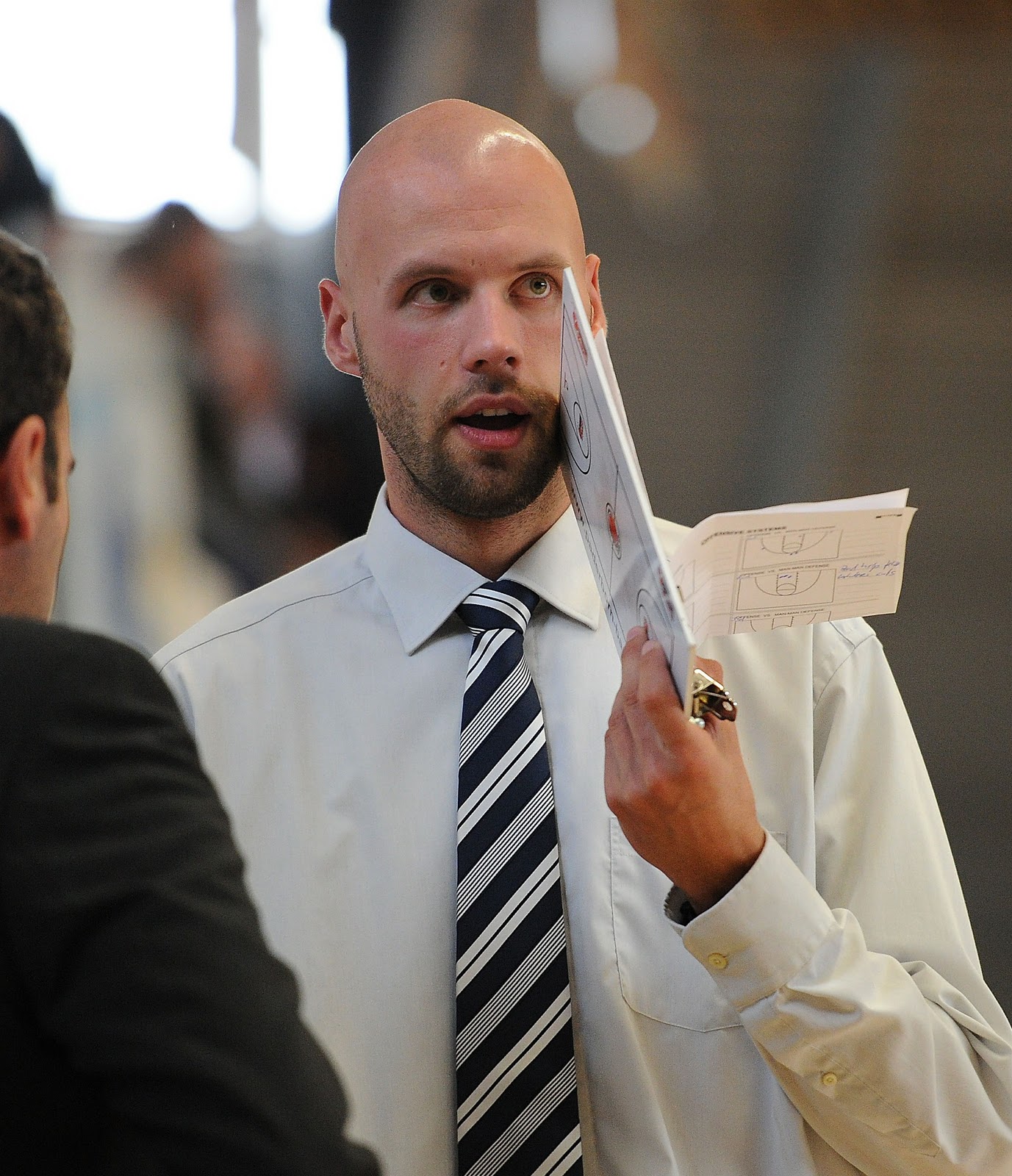
Exclusive interview with German coach Andreas Barthel: Basketball IQ and discipline make the difference!

Andreas Barthel is the emerging star of coaching in Germany. At only 25 he has been named the assistant coach of the Webmoebel Baskets Paderborn in the Beko Basketball Bundesliga (BBL). He is also the assistant coach of the U19 team and the head coach of the Paderborn second team who plays the Regional League. In the 2008/2009 season, Andreas Barthel had a great experience in the United States, being part of the Harker School basketball staff of the West Bay League (Central Coast Section), working both with Boys and Girls Varsity.

Hey Andreas, tell our readers a little bit about you and when did you decide to become a coach.

I grew up in a part of Germany without good basketball programs around and a small number of experienced coaches. Most of the basketball techniques I had to teach by myself, as well as the coaching knowledge. A career as a player was never an option for me. At the age of 19, I dedicated myself completely to coaching. I never had to decide, should I do it or not. Coaching basketball is my profession, my love, my life and already was when I was younger.

We know you had an amazing experience in the US. Was the stay overseas successful?

More than successful. Our overall season record was 24-8 and we entered the Top 15 of the Central Coast Section for the first time in school history. Not the easiest thing with so much basketball powerhouses around in the Bay Area. Finally our season came to an end with a narrow defeat in the CCS Quaterfinals against the later Section Winner Menlo School. One of our players became part of the All-Time Top 20 Scoring list of the State California, scoring more than 1.500 points in 4 years High School Varsity Basketball.
Besides all these facts and stats we had great team chemistry and an outstanding time together. For me personally, I had an awesome time getting to know the American way of teaching, playing and most important living Basketball. Especially the two coaches I worked with, Butch Keller (4 times State Championship Winner) and Jeremiah Brewer inspired me a lot and I'm really thankful that they gave me the opportunity to become part of their program. We are still in contact and one of them just visited me over the summer in Germany.

Which are the main differences between the American basketball and the European one. Did you notice a different approach and organization at any level?

I can just compare the American basketball with the German one and I think there are three big differences.

Professionalism:
As you know, the organization of Youth Sports in the United States is completely different in comparison to the German system. It's not just different, it's way more professional. I had the same responsibilities in a High School Basketball Program as in a Men's Pro Basketball organization in Germany. That includes everything. Daily practises with the team and Individuals, Athletic training, scouting opponents, video analysis, reviews.

Athleticism:
Athleticism is a big factor in the American game. They start lifting weights years before a German kid even has been looking into a weight room. That builds up a strong advantage on the physical side. When you feel strong and are able to use your body you feel confident. And if you feel confident you build up an advantage on the psychological side too. On this way you're able to dominate against opponents.

The status of sports in society:
Sports in the United States are like a social glue. It's a strong medium to transport social values like teamwork, self-discipline and persistence. I had the feeling that everyone is involved in it. Young and old, either as a participant, fan or spectator.

Which is the basketball you like the most. Can you describe it, even giving us some of your technical rules to success? Maybe you have a top level coach who particularly inspired you as a young coach.

In my eyes all starts with great team defense and a winning effort on this side of the court where five guys work together without having the ball in their hands. That's the first step to accomplish success, joy and team spirit. On the offensive end, I prefer a deliberate style of playing the game, where basketball IQ and discipline make the difference and not just the level of athleticism.  In the end it all comes down to the "Willingness to win". Losing is not acceptable, but you should always remember that winning a game isn't everything in life!
For me as a coach, it's very important that I have a dream and goals. You have to have a vision how you want to let your team play and have to teach it with positive passion. Believe in it and make others do the same. I never had just one particular coach that inspired me. I mean, there are so many different types of coaching and playing philosophies and so many coaches using some of them. The ultimate about inspiration is how coaches teach their philosophy, no matter what it is.

What is your next step for a career?

Right now I am really happy with my situation in Paderborn. We have a really young team with a lot of good guys that work hard every day in practise to improve individually and as a group. I feel good about being part of a Pro Basketball organization and one of the top Youth Basketball Programs in Germany and I'm looking forward to a successful season.
During off-season I plan on going back to the States and coach at College Basketball Camps. There are several options for me and it's always good to get in touch with young players, coaches and different basketball mindsets from all around the world.
For me basketball is like a journey. I don't know exactly where the journey is going to come to an end, but that's not the important thing about it. You should always be thankful to be in a position of doing what you love and having the chance to inspire others, no matter where it is or on which level.