Showing posts with label Telegraph Miscellaneous. Show all posts

Monday, January 10, 2011

Q&A with Miles "the Voice" Schmidt-Scheuber: "The future of the German hoops looks bright. Nowitzki and Kaman will play at the 2012 Olympics in London and Tibor Pleiss will make the team in the NBA soon"

Miles Schmidt-Scheuber is the voice and play by play broadcaster of the Deutsche Bank Skyliners on radio since the 2004-2005 season. He has broadcast 270 professional basketball games in this time including 5 BEKO BBL All star games, the 2008 BEKO BBL cup final Artland Dragons-EnBW Ludwigsburg from Hamburg, an ULEB Cup game  from in Rome against Frankfurt and a  international games Germany-Canada with Dirk Nowizki and Germany Poland. He has interviewed well known players like Anthony Tolliver, Shamond Williams, Tyus Edney, Robin Benzing, Daniel Ewing, Carlos Arroyo, Marcus Brown , Marcus Fizer, JR Bremer, Marcin Gortat, Luis Scola, Mario Kasun and Maciej Lampe just to name a few. He has his own weekly 2 hour basketball radio show since 2006. He also writes for Eurobasket.com and German Hoops.Wordpress.com.

Miles, you are the Voice of the Deutsche Bank Skyliners in the German Basketball League (BBL) but you are a journalist and you host a nationally renowed radio magazine. No one better than you can tell Basketball Telegraph readers how basketball going in Germany.

The BEKO BBL season is as exciting as never before. It seems that in the past 2-3 seasons, the league has gotten more and more tight. The first placed team cant take the 18th placed team lightly as Bamberg recently experienced losing to the last placed team Gloria Giants Duesseldorf. Every team can beat every other team. Every weekend there are very exciting games and rarely games where a team has already decided the game at halftime. The league is very competitive and the league has gotten much more athletic in the last 5 years.

I've been in Germany and attended the gyms: it's impressive the atmosphere over there during the games. I do believe the League board was successful with marketing campaigns. Do you still see any room to the next step?

Basketball is still a growing commodity in Germany. A positive development has been the attendance rate which I believe reached 1 millionen patrons last season in the BEKO BBL. The German basketball league finally got a name sponsor in 2009 with BEKO with the help of Gloria Giants Duesseldorf coach Murat Didin and after 5 years got a national TV deal again with Sport 1. The BEKO BBL seem to be making strides in marketing, but it is never easy when a country is led by soccer and has other sports like ice hockey and handball which still garner more interest. A big problem still seems to be the limited media coverage of basketball.

Dirk Nowitzki has been a true factor in the german basketball growth. Will the National Team be ready to keep being competitive when his career will end?

Dirk Nowitzki and Chris Kaman most likely will play at the 2012 Olympics in London and this will be a big chance for the German national team to win a medal. The future of German basketball looks bright and is developing well. Despite not having success at the European championships in 2009 in Poland and at the 2010 World Championships in Turkey, the club has a promising roster of young players. The team has experience with 2005/2007 BEKO BBL champion with Bamberg Steffen Hamann, ACB veteran Jan Jagla,  Dirk Nowitzki friend Demond Greene who grew up playing with the Dallas Maverick in Wurzburg and sharp shooter Heiko Schaffartzik who can decide games on his own, can shoot of the dribble with ease and score in bunches. After that, the team has unending young talent from the birth years 1988/1989. 3 players from the birth year 1988 are Per Guenther who is playing a great season for Ratiopharm Ulm and playing with so much confidence that he could have his breakout season at the 2011 European championships, Tim Ohlbrecht still has unending potential who was already seen as the next big German talent after Dirk Nowitzi four years ago. Ohlbrecht is playing for a very good coach with Michael Koch in Bonn and will be a very important player in the next years for Dirk Bauermann. Lucca Staiger who once scored 106 points when he was 16 is a sharp shooter that got experience at Iowa State and is now playing for Alba Berlin and getting a role in the rotation of Luka Pavicevic. The birth year 1989 has the biggest prospects and highest potential. The four players are Tibor Pleiss, Robin Benzing, Elias Harris and Phillip Schwethelm. The two biggest prospects are Tibor Pleiss and Robin Benzing. Pleiss was drafted by the New Jersey Nets last summer and has been developing nicely in Bamberg. He should be an NBA player in 1-2 years. Robin Benzing had a poor WM in Turkey, but has matured into a big scoring option in Ulm. Last season, he averaged 12.5ppg, 2.5rpg, 1.2apg, and currently is averaging 15,2ppg, 4,4rpg and 1,0apg. He didn’t enter the NBA draft in 2010, but most likely will in 2011. He will be one of the big stars in the German national team in the future. Elias Harris is an interesting prospect that is playing his second season in the NCAA for Gonzaga. Last season, he averaged 14.9ppg, 7.1rpg, 1.1apg, FGP: 54.7%, 3PT: 45.1%. He is very versatile as he is a natural power forward, but has the athleticism of a small forward which he also can play and dazzle you with his shooting. I will be very surprised if he doesn’t have a healthy NBA career. Phillip Schwethelm is a talented forward that is known for his shooting, but has the all around game and is a strong defender. He will be the typical role player in the future that will do his job and make the big plays. In some ways, the German national team is a few steps back to other countries like Spain that develop their players so much earlier. Players like Rickey Rubio, Victor Claver and Sergio llull were already playing ACB in their teens. The key to developing young German players better is recognizing a talented player with 8-12 years instead of 15-17 years.

Do you think it's early to see a German team on the top of the Euroleague?

There are really only two BEKO BBL teams that have Euroleague niveau and they are The Brose Baskets Bamberg and Alba Berlin. Alba Berlin showed last season that they could keep up with the top European teams in the Eurocup reaching the final against Valencia, but losing. The Brose Baskets Bamberg played a very strong euroleague. They beat Olympiakos, Real Madrid and Malaga and lost two tight games to Rome and Madrid by not more than 4 points combined. Bamberg had a lot of misfortune and could of easily reached the next round. Bamberg has the best chemistry and ball movement in the BEKO BBL and are on a healthy route to becoming a final 4 team. One cant forget that a Bamberg might have 6-7 million budget and a Real Madrid between 20-30 million. That makes the differences at the end where a Bamberg and Madrid finish.

Can you tell us more of the best BBL domestic and import players?

The best domestic players I already mentioned in the third question, but have to be Tibor Pleiss and Robin Benzing at the moment. I also don’t want to forget Phillip Zwiener of TBB Trier who has showed the whole German basketball world that when he gets minutes, that he belongs to the best current German players. Zwiener is leading his club in scoring and probably will get invited by Dirk Bauermann next summer for the German national team. The two best import players at the moment are Dashaun Wood of the Deutsche Bank Skyliners who is the main reason the team is in second place despite injuries to AJ Moye and Roger Powell. He is the early MVP candidate as is John Brant who is near unstoppable for Ratiopharm Ulm who is averaging 15ppg and 10rpg and everyone is waiting for his first 20ppg and 20rpg game this season. Other top import players are Torrell Martin, Folarin Campbell, Craig Callahan, Tyrese Rice, Derrick Allen, and Casey Jacobsen.

We know that Soccer is a major sport in Germany. However, have sponsors and businessmen started investing more and more in basketball? How are the clubs going financially wise in this troubled economy?

You might have to ask the teams. Without doing any research, I believe that there might be a gradual increase in this area. It is always a struggle in this area as clubs are fighting for sponsors. The Deutsche Bank Skyliners have been looking for a name sponsor for a long time as times are tough. In the last years there have teams like Rhein Energie Cologne that went bankrupt and teams like Giessen and Trier that made it public that they were having financial problems. The whole problem with getting more sponsors has to do simply with getting more awareness of the sport basketball in the media. You know you're in trouble, if a person comes into a basketball city in Germany and is surprised that there is a basketball team there.

Tuesday, December 28, 2010

"Dealing with Daunting Nostalgia"

Angela Davidson deemed the top female Skill Development Trainer in the Dallas/Metroplex and among the nation's best at the conclusion of 2010. Angela is the CEO/Founder of Non/for profit organizations Kingdom Building Basketball and Universal Basketball Solutions in affiliation with her responisibilities as the Director of Player Development for the Mark Cuban Dallas Heroes Basketball Academy. As a former professional player, Davidson specialized in female Player Development  in addition to creating quality exposure and experiences for academy members through effective mentor programs and professional outlets such as parent organizations in the Dallas Mavericks and Texas Legends.

by Angela Davidson

The idea of playing professional basketball in an overseas venue is one that captures the mind of many athletes, but the reality of nostalgia that can spread like that of influenza in players not poised and prepared to experience international basketball in a world away from home is not.  In other words, this "clause of nostalgia" is not identified nor will it be found within a Player Agreement  or Federal National Letter of Intent although it is the imminent sickness that discourages players, breeches contracts, and ends careers altogether when not calculated. 
According to an explanatory study provided by Holak and Halvena (1992), of the Themes and Emotions in the Nostalgia Experience,  "'nostalgia proneness' has been hypothesized to peak as individuals move into middle age".   This proves that athletes should prepare in preseason and be made aware at all cost to execute efforts to control, prevent, or avoid nostalgia. 

Initially, understanding what nostalgia is according to one's individual experience, temperament should be taken into account. By definition listed in Dictionary.com the term nostalgia is a wistful desire to return in thought or in fact to a former time in one's life, homeland, or to one's family and friends.  For some athletes on a preliminary phase this means that the ideation of getting sick can merely be equated to getting past the airport gate waiving goodbye or something as typical as "traveler's diarrhea".
The importance is that at this point that there is not a dismissal of any possible detriment to a player's well being. In the event that not every player will experience these changes in their digestive tract there are still yet other ailments that can effect a player's physiological equilibrium that can create the onset of the impairment. Discouraging situations by association of recollection of old success or even failures in former systems can derive within the season and defer attention and effort and exhaust a player's mental capacity to fulfill their job description as well.  While discouragements come through on court development elements of chemistry and establishing a common communication factor among foreign teammates often plague a player's performance and distress escalates.  Before a player even recognizes it obscure issues or unfinished business on the home front ranging from familial issues, long distance relationships to what become unavoidable responsibilities, inevitable breeches result that are consequential in worst case scenarios that are career ending situations.  

Wednesday, December 1, 2010

"If winning isn't everything... Why do they keep score?" Vince Lombardi

“If winning isn’t everything...Why do they keep score?” Inspired by this famous Vince Lombardi’s quote, Basketball Telegraph insider Donte Mathis writes about dealing with winning and losing as a professional player.

One of the best quotes I can remember, dealing with the premise of why we compete was stated by legendary former NFL coach Vince Lombardi.  Lombardi summed it up in a humorous way the motivation that has led to the obsession with winning.  People tend to forget professional sports are a business that operates through investors who have invested in potential outcomes of achievement.  These investments and the responsibilities that come with them trickle down from owners to management, management to staff and staff to players. 

As a professional athlete, years and years of training, visualization and competing are done as way of giving us the best possible opportunity to achieve success.  The higher you move up the scale of competition, the more winning matters.  As a kid we played the game for fun as a way to pass time and as our passion grew, the game became more personal, more emotional with its results being sort of a report card of our dedication and what we put into it.  Some may be more talented than others but you reach a point where everybody peaks in that aspect and decision making separates the winners and the losers. 
Winning makes injuries not hurt so bad, it makes the trip home not so long, as well as the following week very short and bearable.  Losing on the other hand, works at you for all that you could have done but didn’t. Of course you will lose a few before understanding and appreciating the importance of what it takes to win, but one thing is for sure.... you will never get a loss back, it’s yours, chalk it up.  I tend to do things a little differently following a loss.... I try to tweak and work on things differently as a way of flushing it out of my system.  Winning on the other hand, causes me to rethink all the things that may have contributed to my success, things that helped me concentrate and perform at that level that led to the win.  I know a few people can/will say, “What if I played great and we lost,” or “If I played bad and we won”.... all I can say is winning will help you deal with not playing well, you will personally regroup and get it going.... I’ll take the win any day.


Everyone has had their moment on a team where things didn’t go their way or they hit a bad stretch of games where they just couldn’t get it done.  A way to get back on the right track is to rid yourself of any negativity or excuses and take some extra time to work on your game.  If you can commit, concentrate and personally make an effort to make the guy next to you better, it’s a step that will put you in the right direction collectively.  Little details often have the ability to be overlooked and they can be a huge deciding factor in winning versus losing. 
We all may not have the opportunity to be in anybody’s hall of fame, but we will for sure remember the successes and losses that add up over time.  We chase winning because it creates a personal legacy within ourselves.....it makes us feel good.... as well as serving as an opportunity to see the fruits of our labor.  Losing humbles us.... it forces us to evaluate commitment, within ourselves and those around us, and should be used as a tool to seek a better opportunity to win.  In competition.....Winning cures all.

Saturday, November 6, 2010

Team chemistry and Basketball IQ are the winning keys to pursue excellence!

Basketball Telegraph columnist, veteran pointguard Donte Mathis, talks about what "chemistry" is being a player and depending on a team sport.

A few years back, skimming throughout the leagues of the basketball world, if you were familiar with a certain league it was pretty predictable knowing who would probably win or lose. Favorites were more clear cut and underdogs remained just that... under. You could look at a team in warmups and understand who had the advantage, who was worried, and who wasn't prepared. The development of team chemistry has elevated the game and we are witnessing more upsets because teams are getting their players to accept their roles as well as play for each other and sharing more responsibility.

Teams have an idea of how important chemistry is and throughout the years the first thing they would do at the beginning of a season would be to isolate the players in a training camp (usually away from their home city)  to develop a bond between each other and let them get to know everyone on and off the court better. You are personally forced to get out of your comfort zone and rely and coexist with teammates. It's a good thing when you have high ambitions because the individual goals of each player can be molded into the team goals. Normally in Europe you can have 2-3 American players per team, and their talent has been relied on for years to get teams over the hump. Talent was dominant for so long and it was the determining factor in the direction most organizations based their teams around... everybody had to have it. Looking at where the game is going and how teams are trying to achieve a consistency with winning... club are spreading more responsibility throughout the team in a clear-cut (stars, role players, rookies) fashion.

In order for this to work the unit has to work together efficiently while respecting each other's strengths/roles. The "lone" star who will individually save a franchise has almost turned into fools gold. It's interesting how chemistry affects a team as well as players... they both need the right fit to flourish. I've seen guys play on last place teams one year to heavily contributing on a championship team the next: same player, same role, same style of individual player. In professional sports there should be a more constant equilibrium because everybody is a pro; team budget can be a factor but it's really who's light bulb turns on first and understands what they have to do to win. Sacrifice is a huge factor in a team being successful. On the teams I've played on that have been successful, the internal talk was always, "set him up and I'll screen him", "if he beats you, I'll be there to help" where as the teams I've played for that were unsuccessful or that underachieved, I always heard "hey hey hey, I'm open" or saw body language and facial expressions that speak harsher and give away more negative energy than words.

Forty minutes isn't a lot of time to make and recover from errors against good ball clubs. Teams that have developed good chemistry recover but limit making the same mistakes often, they are predictable for each other, usually personally ambitious and have the same goals. I've witnessed the habits of good teams and their traits are contagious: the majority is usually focused, committed to sacrifice, skilled in their role and have a consistent basketball IQ. I try to be a good teammate cause it will force other members of my team to respond to me in a certain way. My actions off the court with them have to coincide with my actions on the court, cause if I laugh and converse with them off, then never pass them the ball or help them, I personally risk getting the best out of them. If I was a swimmer, a golfer, or a sprinter, I wouldn't have to rely on anyone but myself, but my well being and livelihood being dependent on a team sport requires me to cultivate the relationships I have with the guys on it.

Saturday, October 30, 2010

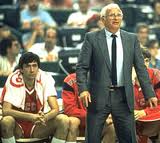
History of Basketball: Naismith Hall of Famer coach Alexander Gomelsky

After the Second World War basketball became one of the most important sports in the former Soviet Union. The National Team was worlwide known as the strong former club "Red Army" and it was totally dominant till the '80's at Euro level, winning 14 European Championships, but also 2 World Championships (1967 and 1982) and 2 Olympics (1972 and 1988).

After the dissolution of the Soviet Empire in 1991, the successor indipendent countries all set up their own national teams. Based on the number of titles, the basketball program of the former Soviet Union remains one of the most successful in the history of international basketball competitions. The Russian National Team was back at high level winning two Silver medals at the FIBA World Championships 1994 and 1998 while the most recent success was winning Gold at Eurobasket 2007 in Spain.

The games between the Russians and Americans during the "Cold War" were memorable and the unforgettable and controversial finals at the Olympics in Munich, Germany in 1972 has become a piece of modern history about the difficult relationship between the two power nations.

Among the most influent characters that built basketball successes in the Soviet Union first and then Russia, needless to say the real "patriarch" was coach Alexander Gomelsky. His story begins in 1945 when the Soviets occupied Warsaw and a few days later liberated Auschwitz: Gomelsky was Jewish,  only 17 years old, and a huge love for basketball. He attended the high school in Leningrad (now St Petersburgh) where he started his career as a coach. In 1966 he took the helm at CSKA. Gomelsky - he was nicknamed Silver Fox - coached the Soviet Union National team for almost 30 years, leading them to 6 European Championships titles, 2 World Championships titles, and the Olympics Gold medal in 1988 in South Korea.
He was the Soviet National team coach in 1972 too, and was expected to coach the team at 1972 Summer Olympics but the KGB (soviet intelligence) confiscated his passport fearing that, since Gomelsky was Jewish, that he would defect to Israel. The Soviets won the Gold with his assistant Vladimir Kondrashin as head coach, thank to a controversial call of a buzzer-beater basket over the USA in the finals.

"At that time there were no clinics, the TV was just born, there were only very few books to study, we were all self-taught - Gomelsky said when he was asked about his incredible career - but we had so much passion and desire to learn". The birth of the European Competitions was a crucial step because it allowed him to travel to foreign countries and experience new styles of basketball. Once retired from coaching, Gomelsky stayed always close enough to basketball, publishing 10 books and becoming a commentator for the Russian television. He was named the president of the Russian Basketball Federation in the 1992, and then of glorious CSKA in 1997. He was also inducted into the Naismith Memorial Basketball Hall of Fame and in 2007 he was enshrined in the FIBA Hall of Fame. The Euroleague annual coach of the year award is named after him, as well as CSKA Universal Sports Hall.
Coach Alexander Gomelsky passed way in 2005.

Wednesday, October 27, 2010

"In Europe I've experienced the bulk of my practice time focusing on timing, angles and concentration" Mathis says

Basketball Telegraph is happy to announce that veteran pointguard Donte Mathis comes on board: Donte starts his collaboration with BT drafting this article in which he analyzes the different coaching styles in the United States and Europe.

From being a fan of the game to being a player, I've witnessed the game of basketball evolving right before my eyes. The game I grew to love as a kid is being taught, played, and followed throughout the world with each country leaving its culture and mark on the game as we know it. The coaching styles I've closely witnessed are the American and European style, which have put aside their egos and self-supposed superiority and have taken positives from each other benefiting the sport hugely.

Legendary coach Bob Knight
Listening to American coaches as a youth I often heard quotes "there is no substitute for speed", "no substitute for strength or height". Early emphasis on physical attributes led coaches to favor the more athletic, physically blessed athlete. Even outside the United States years ago we were seen as athletic, but not highly skilled. The norm is America was to play at a high pace, above the rim and in your face... if you couldn't keep up... then you lost. Coaches felt more comfortable figuring to mold the "athlete" into a complete player rather than solely develop his basketball IQ.

Upon arriving to Europe I didn't know what to expect as far as the style of the game. I knew a few of the rules were different... but it all came down to putting the ball in the hole. My first question to all of my coaches throughout my professional career in Europe was "What are your personal expectations of me?". Early in my career I heard "score", mid to later in my career I heard "Get everybody involved and make your teammates better". European coaches and the Euro game in general are focused on TEAM. The biggest task with coaching in Europe is developing cohesion, trying to mesh the foreign and domestic, experienced and inexperienced. Chemistry is valued more than talent or athletic ability. European teams are basically a huge puzzle... pieces have to fit in order every game throughout the season to be successful. Some pieces are bigger and more valued, but every piece is viable. In Europe I've experienced the bulk of my practice time focusing on timing, angles, and concentration, while playing back in America I remember errors were considered by the number of shots you missed, the personal challenges won or lost within the game... on the contrary the greatest thing I learned while playing in Europe was the biggest mistake you can make is not being focused. Concentration and focus are the biggest assets in being successful in the European game. European coaches stress concentration and focus, they both have an ability to control what your body thinks it can or can't do.

Euroleague: coach Ettore Messina
Fast forward to today... and you will witness something very strange. American players can shoot, and European players are tough as nails. A result of espionage? ... Not at all. The worldwide spread of the game of basketball has offered the coaches of the world the opportunity to observe and exchange ideas. Coaches haven't sold everything they believe in but have instead carefully picked and implemented the things that can make their brand of basketball more efficient, or harder to guard. More emphasis today is put on player development. Coaches are getting the most out of player's ability by thinking outside the box and getting right to the things that will give their players the opportunity to be better on the court and in their system. I have personally stole everything possible from everyone of my coaches in the past trying to get the most I could out of my talent. I don't lean to any side particularly more than the other, but I take what works and helps me and use it the best I can.

Tuesday, October 12, 2010

Ron Artest provocation: "There's no balance..". Too many non-Americans in the NBA?

Is the NBA board or Commissioner David Stern thinking to put a limit to the number of  international players in the League? This sounds like a shocking project: is there something real in that idea? America has always been open but something could change in the next future.
The NBA has become in the recent years a melting pot of players from all the nationalities. There are almost one hundred ballers non-Americans in the League, lots of them just make the team but no more than a dozen of them have an effective impact on the game.

Does the NBA need to keep the door open to international players when thousands of Americans have to ball overseas at any level, from the Euroleague to the Careebean leagues or North Africa for a living? The topic is serious, even more in a so troubled economy.

Maybe the big media didn't take too serious what Lakers forward, Ron Artest said  when on tour in Europe with Kobe and co. the other day about the international leagues: "They need to let more Americans play in the European leagues".
The provocation of Ron Artest hit the core of the problem. With the exception of the Euroleague, all the domestic major leagues - like the spanish ACB, the italian Lega A, the greek league and the russian one.. -allow a maximum of two-three non-europeans per teams. Is that fair comparing to the NBA?

The Ron Artest analisys makes sense if you think about the Milwaukee Bucks but even to the Toronto Raptors.
"You see a lot of foreign players - Artest said - come over to America to play in the NBA. It's not fair that a lot of American players can't come to China or can't come to Europe to play with as many players as they want, so there's no balance.. They should just make it more even".
What might it happen if the NBPA (National Basketball Players Association) should decide to threaten a strike to defend more jobs to Americans?

Saturday, October 9, 2010

Exclusive reportage from Lithuania: from Sabonis to the next superstars, the country where basketball is an art

Lithuania is a european country with an area of 25,200 square miles situated along the southeastern shore of the Baltic Sea and its population is approximately 3.5 millions. Religion is Catholic..but if you ask any lithuanian what is his religion he will answer: Krepsinis! Needless to translate, it's basketball.
Yes, basketball is the main sport practised with unbridled passion of the people of this country. It's amazing how any person in any place, on the street, at the bars, at work talk about ball. The history of basketball in this country is founded in the first decades of the last century, imported by an aviator, Steponas Darius. If you think that the days in the Baltic region are long and cold and that darkness comes early, we can deduce that this was the ideal sport to keep fit, stay together and have fun in the appropriate facilities.

Arvydas Sabonis
 The Lithuanian National team won two European Championships in 1937 and 1939, just before the II World War. Pranas Lubinas was the coach who helped popularize basketball in the country and was called the "Grandfather of Lithuanian basketball". Meanwhile, Lithuania was annexed by the former Soviet empire but Lithuanian players kept forming the core of the Soviet National team. That was especially for the historical 1988 Olympic where the russian basketball National team won the Gold medal. That fantastic squad had four lithuanian talents such as Valdemars Chomicius, Rimas Kurtinaitis, Sarunas Marciulonis and Arvydas Sabonis. That time the games at international and domestic level between Zalgiris Kaunas and CSKA Moscow were epical. This challenge is still alive nowaday when the teams play at Euroleague level, where Zalgiris and CSKA is like an ultimate fight for upsetting the archrivals on and off the court.
The disintegration of the Soviet empire finally makes Lithuania an independent country in 1990.
Sabonis was in the past and still is a true legend for the Republic of Lithuania. Nicknamed "Prince of the Baltic" he was one of first players with great tonnage (220cm tall and 130kg) with the ability to play like a guard. He was equipped with pianist's hands, had a soft touch and his fundamentals basic movements just comparable to a dancer. Furthermore, his vision of the game was spectacular and his IQ superior.  He was also the first baller to play in the NBA even getting over there maybe after spending his best years of the career in Europe. Unfortunately he could sign in the NBA only at 30 years old.
Once the political situation changed with the dissolution of the former Soviet empire Sabonis was free to go to America, but first he opted to play in the Spanish league for 6 years, 3 at Valladolid and 3 in Real Madrid, where he became a global star. In 1995 Sabonis finally landed in the NBA, and although a 30 years old veteran with no experience of the American basketball he had an impressive impact on the team that hired him, the Portland Trailblazers. He was the first european ever to play as a starter producing big-time numbers, averaging 14ppg, 8.1rpg, 1.8apg and 1.07blk.
Sabonis and the shooting-guard Marciulonis with the Golden State Warriors opened the door to the next talents on the world stage like Sarunas Jasikevicius, Ramunas Siskauskas, Darius Songaila, Mindaugas Zukauskas, Saulius Stombergas and many others.

Zydrunas Ilgauskas
 One thing stands out immediately when you scout the Lithuanians: their basketball is close to perfection in every detail.  But where you can see the lithuanian trademark is shooting: they are deadly shooters. Behind every shot there are hours, months and years of hard work. The accuracy of the Lithuanin players prove that. It does not matter if you are tall 2.30 or 1.50..shooting in Lithuania is a pure art. Yes, over there it is not a fundamental..but art.
They really have dozens of lethal shooters: the most recent names are Sarunas Jasikevicius, Saulius Stombergas, Dainius Adomaitis, Ramunas Siskauskas, Rimantas Kaukenas, Mindaugas Zukauskas, Arvydas Macijauskas, the twins Darius and Ksistof Lavrinovic and even the NBA star Zydrunas Ilgauskas, a 220 giant who runs and plays smoothly like a guard.
Unfortunately nowadays the fundamentals of basketball are no longer treated and trained like in the past. Today we all focus mainly on physical talent and athleticism. But if you are romantic and want to see again the old school basketball fundamentals, the ones that still make the difference in the game, then take a trip to Lithuania. No matter where or which city. Lithuania is a small country, you can easily choose to stay in any city, from the capital Vilnius to Kaunas, from Klaipeda to Siaulai, from Panevezys to Kedainiai..and if you really want to see the fundamentals still taught and practised, you don't need to attend a spectacular game of the Euroleague or of the Lithuanian LKL league..go to any gym where you can attend a practise of some youth program and you will soon realize that the talent, the enthusiasm, is still alive in the Lithuanian kids like it was for the past generations and this way you will see the big-time players of tomorrow!

Wednesday, September 29, 2010

American rookies in Europe. The rules to be successful. The experiences of Terrel McIntyre and J.R. Holden!

The following is a guest blog from Basketball Telegraph columnist Dr FingerRoll. We have asked him to draft an article about american rookies and how they can be successful in Europe. The article is very interesting.

"Adapting to the new environment, getting comfortable in the new place, learning the rules, having a goal and working hard, these are the keys for a successful rookie that wants to make it in Europe" - Terrel McIntyre

Is it about talent? Yes, it is.
Is it only about talent? No, it is not.
We are talking about successful rookies who come from the United States to Europe to start their pro careers. Some of them, a small percentage, go back to the United States after a year or so ready to shine, or at least to have a career as role players, in the NBA (Brandon Jennings, James Singleton, Maurice Evans to name just a few), others will become "Europeans" and enjoy a 10 year stint in the Old Continent beginning in unknown countries to climb the stairs of success and make it to the highest competition of the best leagues (Spanish, Italian, Russian, Greek, Turkish, French and German) and ultimately to the Euroleague.
There is also a big percentage of american rookies who do not learn much from the european experience and go back to the States to try and (re)build their hoops future in the minor leagues or dreaming a call-up from the NBA playing in the D-League.

We said it is not only about talent. Gifted players like Brandon Jennings for instance have more chances to make it, but players like Terrel McIntyre or "Russian" superstar J.R. Holden did not receive any attention after graduating from college and they had to walk the steep and tough road of success.
Take Holden, for exemple. He graduated from Bucknell in 1998 and, a few days before starting looking for a "real job" (his words) he received a call from Riga, Latvia, where a local team was offering a contract (USD 3.000 a month) to play the 1 spot. He accepted. Flash forward to 2010: at age 34, J.R. Holden won championships in each country he played (Latvia, Belgium, Greece and Russia), he became a Russian citizen and led the National Team to the gold medal at the 2007 FIBA European Championship where he scored the winning basket in the finals against Spain. And, mind you, he was nobody at college or at least not a high caliber and didn't have the athletic skills nor the size of many other players that didn't make it.

The key, when you are out of your element, is adapting to the new environment, to make yourself at home in a foreign country and to have a goal and be humble.
In an interview Holden said that at first the language barrier gave him the impression that people were cold. "My teammates told me just to give it time" he said "and they were right. I began to realize how friendly people actually are in Russia". And it is so much easier to perform at your best when you are enjoying your time off the court or at least when you don't see the trip overseas as "just work".

Another key to success is, and that is no news, hard work and adapting to the new rules on and off the court. Many times we saw players coming to Europe thinking they would teach coaches and other players "out to do it". Wrong move.
It might be a different game and there might be rules that seem crazy (not to mention the refereeing) but that's the game in Europe and the sooner you learn the tricks of the trade the sooner you will be on the right track to be successful.
And, again, having a goal always helps. "To play well is always difficult - McIntyre says - you have to work hard in order to be good. At the early stage of my career in Italy I watched the Euroleague and I knew that was the level I wanted to be at and I knew that if I worked hard it could happen". And it did happen to T-Mac. Three times MVP of the Italian Lega A with the green jersey of powerhouse Siena, McIntyre after flirting with the Lakers and the greek outfit Panathinaikos, signed in Spain and will run Unicaja Malaga in the next ACB (Spanish) league.

There are also some aspects that you can't totally control, such as the organization you end up playing for and  some adjustments you need to make in your life like different food, not having the dryer in the apartment or driving a car with stick - these are the most difficult stuff to deal with for an American baller when in Europe - and, for rookies, it should be a big luck to play with experienced players to get advices how to play in Europe and how to manage pressure as an import player.
"When I got here I talked to guys who made it" says McIntyre "guys like Trajan Langdon or J.R. Holden and I was lucky enough to have Bootsy Thornton in my team who already made it to the Euroleague Final Four and who was able to talk to me about being successful in Europe and the work you got to put in".
Adapting to the new environment, getting comfortable in the new place, learning the rules, having a goal and working hard, these are the keys for a successful rookie that wants to make it in Europe.


Wednesday, September 22, 2010

Coach Alan Stein: 3 Keys to Success! The trainer of Kevin Durant writes for Basketball Telegraph!!

The following is a guest article from coach Alan Stein.
Alan Stein is the owner of Stronger Team and the Head Strength and Conditioning coach for the nationally renowned, Nike Elite DeMatha Catholic High School boys basketball program. He spent 7 years serving a similar position with the Montrose Christian basketball program. Alan brings a wealth of valuable experience to his training arsenal after years of extensive work with elite high school, college and NBA players.

"Coach Stein helped me gain nearly 20 pounds my senior year at Montrose and continues to work with me to this day. The added size, strength and explosiveness he has helped me gain has made me a better player on the court. He really helped me make the transition from high school to college and from college to the NBA" - Kevin Durant


You need talent, luck and persistance. Pick any two if you want to be successful.

Wheter you are a basketball coach or a player, you can reach your (realistic) goals and achieve a high level of success with just two of those three.
Don't believe me? Let's take a look..

Talent

To some degree, what most people refer to as talent, is nothing more than passion. If you love to do something... you will do it every chance you can. And the more you do it, the better you get. Now obviously there are several uncontrollable factors that determine someone's ultimate talent and success on the basketball court (height, athleticism..) but in many instances, talent comes from non-stop, obsessive practise. I have never met a lethal shooter who didn't practise all of the time... who didn't shoot thousands and thousands of shots every single week. Being a talented shooter is 100% controllable.

There is no debate that Kevin Durant was born with numerous physical gifts. But so are a lot of people. So how come KD is an NBA All-Star and the league's youngest leading scorer of all time and other 6'9" guys don't play past high school or college?
Because KD has an unparalleled passion for basketball and he works on his craft every single day.

Same goes for coaching. Who are some of the most talented coaches in college basketball? Coach K? Tom Izzo? Jay Wright? Do you have any idea how much time and effort those guys have put into their coaching skill sets? They love the game of basketball and work relentlessly at becoming the best they can be.

And talent doesn't have to be all encompassing. You don't have to be good at everything. You just need to have a specialty... a specific talent that makes you stand out. It might be defense (Bruce Bowen), it might be rebounding (David Lee) or it might be shooting (Ray Allen). Working on your weaknesses is important, but so is making your strenghts even stronger!

Talent is the ability to make the most of what you have with where you are.

Luck

Honestly, I don't believe in luck. I think unsuccessful people use luck as an excuse. I believe luck is when preparation meets opportunity. I love the quote, "the harder you work, the luckier you get". There is so much truth to that statement. So that means, in order to be lucky, you need to be well prepared when opportunity knocks.

Do you even know how to prepare? Players, what do your daily workouts consist of? Do you just jack up 300 shots or do you take game shots, from game spots, at game speeds? Do you practise ball handling drills looking down at the ball or do you force yourself to look up (even though you may lose the ball initially)? Do you visualize a defender in front of you when making moves to the basket or do you just do the drill? Do you have a solid strength and conditioning foundation or do you just play pick-up? Equally important, are you a great teammate? Are you the type of player other players like to play with and coaches like to coach? Trust me... you'll be a lot luckier if you are!

Coaches, do you just study the X's and O's or do you work on communication and leadership? Do you put all your focus on your out-of-bounds plays or do you spend time learning how to most effectively communicate with every member of your program? Do you reinforce great work habits with your players 365 days a year? Do you read, watch film, and network with other coaches?

I realize many resources cost money... camps, clinics, DVDs, and trainers, which can be a limiting factor for some. However there are numerous resources that don't.

If you want to be lucky, you need "to be in the right place at the right time". Instead of waiting for that to happen, you need to make an effort to create real value in every place you go and every person you come in contact with.

When opportunity knocks, will you be prepared to answer?

Persistence

This one is pretty obvious. Dont' give up on anything you can't go a day without thinking about it. Never quit. Keep practising. Keep working. Most people think they are persistent but in reality, they give up after a couple of "no's" or a few minor failures. Be too stubborn to quit. Dont' be so pig-headed you won't try new approaches or make adjustments along the way... just don't quit. Ever.

My twin sons, Luke and Jack, are 6 months old. They have an unyielding persistence. They don't stop until they get what they want! They are relentless and they don't take no for answer. While that has certainly caused me a handful of sleepless nights, I hope it is a quality they never out grow. If they apply the same persistence to the game of basketball as they do to wanting to be fed... they will indeed be McDonalds All-Americans in 2028!!

Bottom line is this. If you want to be successful, on the court, or in anything in life:

Make your own talent. Make your own luck. Never quit.

Sunday, September 12, 2010

Coach Forrest McKinnis: Motivating a team with superior talent

Coach Forrest McKinnis has 10 years of head varsity coaching experience with multiple levels of success. In 2004, the former graduated of Eastern Oregon University coach McKinnis led his team to the school's first ever #1 ranking in the state polls. He is the founder of Coach Mac's Basketball Resources  (http://www.coachmac-basketball.com/), was a Conference Coach of the Year in '02, '04, and '05, was selected to coach the Gatorade All-Star Series in 2004, and was voted Educator of the Year in 2006. Coach McKinnis is also the author of more than 20 playbooks.

In 2004, it didn't take me long to discover I had one of those special teams; a team for a decade in our small quite community and a team of a lifetime for any coach. It seemed as though this team took care of everything without proposition - from the classroom to the court they were "winners". They were driven, played with a high level of passion and ironically they were blind to their potential. The team chemistry was seamed together with a bond of kinship not sold in any "how-to" book.

The point-guard, my team captain, was cut from the perfect leaders mold. The forwards were dynamic, and the post was soon to be the biggest surprise in the state. In short, they were good, they were really good and they knew it. It wasn't long before I realized we were afflicted with a single-but potentially fatal flaw: we lacked motivation. As a coach, it was my job to saddle this group of superior athletes with a sense of motivation. So, how do you motivate the top athletes who are not driven by competition alone?
The answer: Zoom Focus.

Zoom Focus is a mental state of mind which can only be achieved through proper psychological advancements. Zoom Focus - or mental clarity - is the center piece of success. How as coaches do we introduce and vale, zoom focus?

The answer is found in four steps:

Superior athletes search for internal motivation from external accomplish.
First, superior athletes must set goals based on self-determination and extrinsic motives. Second, as a coach use extrinsic rewards. "Player of the game" awards work well in this sense if the award is presented in front of the team. Third, motivate with music. Music can be used to create the perception  of inspiration. Finally, introduce the athletes to positive self-talk.

Positive self-talk is a technique that can be used to enhance motivation across a wide range of achievement domains. It makes use of the athlete's powerful inner voice to reinforce their self-esteem or important aspects of their performance.

Wednesday, September 8, 2010

NBA next stop: Europe!

The Commissioner of the NBA, David Stern, has spent the last 10 years promoting the NBA expansion.

Something could be happening after the Olympics 2012 in London. There are many NBA-style arenas ready in Europe and lots of businessmen interested in running this plan. Insiders say that there are talks and something is sizzling out. London and Berlin have amazing arenas, Rome, Milan but even Madrid, Barcelona, Athens or Tel Aviv might soon follow suit.

The David Stern concerns are not about money or finding businessmen interested to join with a european franchise the NBA. The commissioner who leads the League that is a model for professional sports in public service, league operations, global marketing and technology knows exactly that the fascinating project must  be prepared perfectly. He knows that the NBA may still be the best basketball league on the planet, but it is not anymore the only league willing to pay big salaries and players and their agents know it. And for the expansion of the League, its brand the commissioner has his own very solid strategy to be successful: to strike root in new countries, cities and enlarge the sphere of the business to new fans in what it will become the "Global Basketaball Association".

In this troubled economy where the euro sometimes dwarfs the dollar you have to necessarily think new stategy. The Euroleague has been a big success so far, and David Stern knows that very well. Even the dynamics of players market has changed a lot: big-time players has signed in Europe and even more have considered the option. An interchange is in act, but David Stern can't plan a merger with the Euroleague, and he needs to expand the NBA and maybe take over or add top european clubs eager to be in the next worldwide NBA. Maybe the only big issues are related the different financially wise rules: in Europe the salary cup doesn't apply for instance, and the tv rights are dramatically lower than in America so far.
But there is no doubt that they are working to plan how to harmonize the rules preparing the next big impact on the global basketball: some european franchises in the NBA. And who knows, maybe soon even in Asia (more Japan than China right now) for the years to come.

Monday, September 6, 2010

The truth about the NBA vs European basketball

The following is a guest article from a very intelligent player, Evan Harris. His capacity to understand and analyze the game is incomparable. Evan is a Los Angeles native professional player and former graduate of Harvard (2009). He is about to start his second  season in Europe playing for Illiabum, in Portugal. Last year he started playing in Romania for Craiova then he moved to Germany where he played for Wolfenbuttel.
I really thank Evan for his contribution given to basketballtelegraph.com with his analisys on the main differences between the NBA vs European basketball.

I was asked to do this blog as sort of a re-issue of an older blog I had written on the subject. At the time, I was a rookie playing in Germany and had gotten into a pretty heavy conversation with one of my teammates about the differences between the NBA and the European game.  Right after this conversation, I came home and watched the highlights of a couple of Lebron's dunks, and some things stood out to me..

Okay, so let me first start off by saying I mean no offense to anyone (European or American) by this post.
These are just my observations after almost a full year of European basketball and 4 years of NCAA basketball and nearly 20 years of studying the NBA game.
With that being said, everything is a trade off. What I mean by this is, what Europeans may lack in one area, they make up for in another and viceversa.
Anyways, the first MAJOR difference I have seen is the speed/athleticism of the individual players. In America, the game seems sped up, and the game itself is more geared towards scoring and helping out individual scorers. During the conversation with my teammate, Brandon Jennings was brought up as a perfect example. He played at both a high level in Europe, and in America - so he serves as the perfect comparison. Statistically, his one season in the Euroleague produced 7.6 points, 1.6 rebounds and 1.6 assists per game (over 16 Euroleague games). Conversely, last season he has averaged 15.7 points, 3.4 rebounds and 5.7 assists (over the 82 NBA games).

The (in my mind) incorrect conclusion to the dramatic difference in numbers would be to assume that the Euroleague competition is somewhat tougher than the NBA competition. While this is undoubtedly a debatable point, I believe the reality is that the NBA game is just geared more to showcase individual talent while the European game is much more team oriented. You need to look no further than the averages of the scoring champion of each league for that point to be illustrated. The Euroleague scoring champion (former Denver Nugget Linas Kleiza) led the league in scoring at 17.3 points a game. In comparison, Kevin Durant who ended up winning last year's NBA scoring title averaged 30.1 points a game. Nearly double Kleiza's output.
Now the question is...WHY? Yes, Kevin Durant is a much better scorer than Kleiza is, but it also doesn't help that the rules of the NBA facilitate one on one scoring much more than the European game does.
Which brings me to Lebron's dunk. You will see that the help defense is not existent. A couple years ago the league introduced the "Defensive Three Second" rule. The rule itself states that, "Any defensive player, who is positioned in the 16-foot lane or the area extending 4 feet past the lane endline, must be actively guarding an opponent within three seconds. Actively guarding means being within arms length of an offensive player and in a guarding position".
For you non basketball enthusiasts, this means that you can't be in the key for more than three seconds without reaching out and touching an offensive player. This pretty much eliminates the idea of a "help side", which from middle school on you are taught that if the ball is on the opposite side of the court to at least have one foot in the key, and often to be standing on the "basket line" or directly under the rim. This help side effectively shrinks the floor, and makes it much harder for the offensive player to score (it turns a one on one situation to a one on 3-4).


Anyways, to the video... Watch specifically that before Varejao's post up, the other 4 defensive players are standing outside the key, essentially letting Lebron go one on one with James Johnson while the other 8 players watch..
Because of the Defensive Three Second Rule, there is no way the help can get there in time if Lebron (or any NBA level athlete) takes one dribble from the free throw line and takes off. Unfortunately for James Johnson, he isn't playing in Europe where that play would have undoubtedly ended in a charging call on Lebron (they also didn't have the protected semi-circle under the basket, but it is making its way to Europe for next season).
There isn't much of a point to this, just to point out one of the biggest things I have learned/had to adjust to since arriving here.

Another big difference that often gets overlooked, is the strategy/focus of each team. Obviously, both teams in the NBA and in Europe are geared towards and built to winning. However, with the star and marketing power of the NBA, it is inevitably also geared for the stars to shine. Not to say that there aren't stars in Europe, but the whole team concept is stressed much more. For example, if you look at a typical European offensive set, it is often a lot of continuity, breaking down to a pick and roll late in the shot clock. In stark contrast, many typical NBA offenses are simply a pick and roll with a little bit of movement off the ball. Looking forward, it will be interesting to see what kind of difference the recent change in FIBA rules does for the European game. Most interesting for me will be the inclusion of the restricted area under the basket and the removal of the trapezoidal key in favor of the NBA's rectangle..

Thanks for reading and feel free to comment with any insight you may have!

Monday, August 30, 2010

Just wondering..

..which is the best crop for basketball in Europe.

It would have been easy to answer this question twenty years ago: Yugoslavia, no doubt. Nowdays people can disagree or have different opinions. And they are right and what they say it worths respect. Well, that means the competition is much bigger, and that's good either for the level and the interest of fans and for the uncertain results of the international competitions under FIBA. After disintegration of former Soviet Union and former Yugoslavia in so many small indipendent countries we can see a bunch of new strong european National teams very competitive at any level. You never know who's gonna win. And superstars come out from any country from the Old Continent.

Where we just had the Soviet Union now there are Russia, Lithuania and also Ukraine who can excel at high level or they can offer outstading NBA materials.
Once upon a time Yugoslavia, yeah: now we have Serbia, Montenegro, Croatia, Slovenia. Do you want some names of their talents? Here we go: Sasha Vujacic, Brezec, Nachbar, Nesterovic and Dragic (and many more) from Slovenia; former NBA champion Divac from Serbia like his compatriots Danilovic and Jaric in the recent years, or the new emerging stars of Euroleague Teodosic, Tripkovic, Teletovic or even more Novickovic, Macvan, Dragicevic; the croatian Igor Rakocevic, Roko Leno Ukic or the Draftable Zubcic while the aged people will remember for sure the unforgettable Drazen Petrovic and his teammate Dino Radja.

From Lithuania we have the unstoppable Linas Kleiza, Kaukenas, the Lavrinovic twins but, still remembering the first (and maybe best ever) Arvydas Sabonis we have enjoyed with Siskauskas or we are now waiting for next superstars Valanciunas and Motejunas.
Spain is a wonderful crop as well - the best center of the NBA is nowadays Pau Gasol (okay with Dwight Howard) and the outstading Ricky Rubio - and many guys made the team in the NBA like french themselves either. Germany hero Dirk Nowitzki has been a NBA MVP candidate in the last 5 years while italian Andrea Bargnani was a 1st rounder pick of the lottery and a franchise player today.
Yes, which is the best crop for top level players is really questionable. From East to West, from South to North (yeah, we have also Jerebko and Koponen or Luol Deng) we can count fantastic players. Amazing topic.

When you see in Romania teams playing like the Lakers

Almost all the teams of the professional leagues have started working hard in these first days of the training camps.
The phone cells of the GMs are always hot though. Better to be updated. You never know. Maybe around the corner you can find the perfect addition to your squad, and agents are lowering the prices of clients still available in the meantime.

It's like stock market, even for ballers the budget fluctuations are related on economy first, but also on your resume, the last stats and the trend of coaches. Of course you have to handle carefully your demands, because every more day you will lose jobs.
Sometimes it happens that some positions are "in" while due to the new rules of the game you can see old-style centers being "out" of the market. Yeah, it's a matter of being fashionable: when some powerhouses win with combo's in international competitions or in some top leagues, you will see at any level coaches yelling at their GM's they need combo's to be competitive.

Coaches like to be followers. It's sumetimes ridiculous. They want so much to feel themselves like they are close with technical ideas to the most valuable colleagues of the business. It's a human weakness to act like this. Well, if you are not coach Bobby Knight or Phil Jackson or the multi-winner Zeljko Obradovic at Euroleague level, for sure you can always say to your friends that your team has the same plays of the best teams in the NBA or in ACB. It's possible to see teams in Romania playing like the Lakers. Even at lower level or in youth programs. Maybe it's sometimes funny but also the nice side of this game.

Players and Agents

It's not that easy for ballers to choose the right agent. It's not a matter of picking the good or bad, but the athlete would ask himself: is that one the right professional for me? Integrity is always an asset, networking overseas also but who is good for Kobe maybe he is not for an average rookie looking for his first job in some unknown country in Europe.

That's the point. Every player would take the right info's for hiring his own agent.

Usually players when just graduated aspire to be listed under big-time agencies. It's a human desire to be part of a superagency wellknown in the business. They think this way to win their lottery in being signed by the best organizations and for big money. That's wrong, of course. Who works for Melo or Chris Bosh maybe won't be available to spend hours on phone to push an average kid from Division II to Belgium or Macedonia. Or even worse he won't be able to do that, if he doens't know any colleague or GM's in Europe. Why? Because a big-time agent maybe run 25 superstars in the NBA but he doesn't know anything of the level of the european countries.

Ballers are often stubborn and arrogant and usually overrate their skill-sets. And moreover they love when some attorney tell them they worth six figures deals. Of course that is far from reality and from what it will happen later on. The agent will be fired to have lied all the time to his client while the player would waste time, money and jobs.
The agent should be the honest advisor but who suggests the player to sign for that specific agent? Big question. Lots of ballers have their own mentors, some have older family members who were players as well or maybe they are connected to the industry. But how a youngster when 21 can opt for the right choice for an agent that must start planning his career? Not easy. Being reasonable it sometimes fights with aspirations and dreams. People don't like to be pragmatic. Guys are always attracted by street agents talking big.
And college coaches are too often playing for doing favours to friends or friends of the friends and not necessarily for giving the most honest and transparent support to naive guys. Yeah, it's a big question. Who is the best agent for you? But above all who takes care in guiding youngsters to smart professionals who should be gonna advice you to start playing pro basketball?